what is ict information and communication technology
What Is ICT (Information and Communication Technology)? A Complete Guide

What Is ICT (Information and Communication Technology)? A Complete Guide
In today’s digital world, technology plays a vital role in almost every aspect of life. From sending emails and making video calls to managing businesses and accessing online education, technology has transformed the way people communicate and share information. One of the most important concepts behind this transformation is ICT, which stands for Information and Communication Technology.
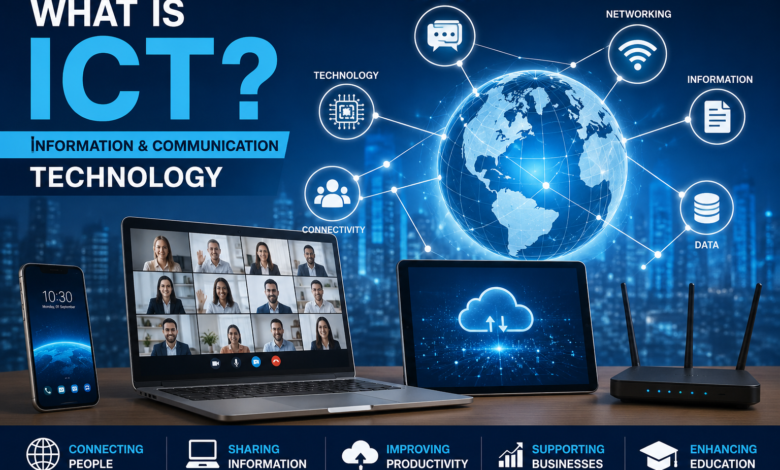
ICT is a broad term that covers all technologies used to handle telecommunications, computers, software, networks, and digital systems that enable users to access, store, transmit, and manipulate information. Whether it is a smartphone, a laptop, cloud storage, or social media, ICT is the foundation that makes modern communication possible.
Understanding ICT
Information and Communication Technology refers to the combination of technological tools and resources used to create, process, store, retrieve, and exchange information. It brings together information technology (IT) and communication technologies to improve connectivity and information sharing.
The primary goal of ICT is to make communication faster, more efficient, and more accessible. Through ICT, individuals, businesses, educational institutions, and governments can communicate and collaborate regardless of geographical location.
Components of ICT
ICT consists of several key components that work together to support communication and information management.
1. Hardware
Hardware includes physical devices used to process and communicate information. Examples include:
- Computers
- Smartphones
- Tablets
- Servers
- Printers
- Routers
These devices allow users to access and manage digital information effectively.
2. Software
Software refers to programs and applications that run on hardware devices. Common examples include:
- Operating systems
- Web browsers
- Office applications
- Communication tools
- Mobile apps
Software helps users perform specific tasks and manage digital information.
3. Networks
Networks connect devices and allow them to communicate with each other. Examples include:
- Internet
- Local Area Networks (LAN)
- Wireless Networks (Wi-Fi)
- Mobile Networks
Without networks, modern communication would not be possible.
4. Telecommunications
Telecommunication systems enable long-distance communication through various technologies such as:
- Telephone systems
- Video conferencing
- Satellite communication
- Mobile communication networks
These technologies help people stay connected around the world.
5. Data Management
Data management systems help organizations store, organize, and analyze information efficiently. Databases and cloud storage solutions are common examples.
Importance of ICT
ICT has become essential in modern society because it improves communication, productivity, and access to information.
Faster Communication
People can instantly connect through emails, messaging apps, and video calls. This has significantly reduced communication barriers.
Easy Access to Information
The internet provides access to a vast amount of information, allowing people to learn, research, and stay informed.
Improved Business Operations
Businesses use ICT to manage operations, communicate with customers, and increase efficiency through automation.
Enhanced Education
Students and teachers can access online learning platforms, digital resources, and virtual classrooms from anywhere.
Better Government Services
Governments use ICT to deliver online services, improve transparency, and communicate with citizens more effectively.
Applications of ICT
ICT is used in many sectors and industries.
ICT in Education
Educational institutions use ICT for:
- Online learning
- Digital classrooms
- Educational software
- Virtual collaboration
- E-learning platforms
Students can access learning materials anytime and anywhere.
ICT in Healthcare
Healthcare organizations use ICT for:
- Electronic medical records
- Telemedicine
- Patient monitoring systems
- Online consultations
These technologies improve healthcare delivery and patient care.
ICT in Business
Businesses rely on ICT for:
- Customer relationship management
- Digital marketing
- Online transactions
- Remote work
- Data analysis
ICT helps organizations remain competitive in a rapidly changing market.
ICT in Banking
Modern banking systems use ICT for:
- Online banking
- Mobile banking applications
- Digital payments
- Automated teller machines (ATMs)
These services provide convenience and security for customers.
ICT in Government
Governments use ICT to provide:
- Online public services
- Digital documentation
- Tax filing systems
- Public information portals
This improves efficiency and accessibility for citizens.
Benefits of ICT
There are many advantages associated with Information and Communication Technology.
Increased Productivity
ICT tools automate repetitive tasks and improve workflow efficiency.
Global Connectivity
People can communicate and collaborate across countries and continents in real time.
Cost Savings
Organizations can reduce operational costs through digital communication and cloud-based solutions.
Better Decision-Making
Access to accurate and timely information helps businesses and governments make informed decisions.
Flexibility
Remote work and online collaboration allow people to work from different locations without interruption.
Challenges of ICT
Despite its many benefits, ICT also presents several challenges.
Cybersecurity Risks
Hackers and cybercriminals can target systems, leading to data breaches and financial losses.
Privacy Concerns
Personal information stored online may be vulnerable if proper security measures are not implemented.
Digital Divide
Not everyone has equal access to technology and internet services, creating inequality.
Technology Dependence
Overreliance on technology can lead to problems when systems fail or experience technical issues.
Continuous Upgrades
Organizations often need to invest in new technologies and employee training to stay current.
Future of ICT
The future of ICT is expected to be shaped by emerging technologies such as:
- Artificial Intelligence (AI)
- Cloud Computing
- Internet of Things (IoT)
- 5G Networks
- Big Data Analytics
- Blockchain Technology
These innovations will continue to improve communication, automation, and information management across industries.
As technology advances, ICT will become even more integrated into everyday life, transforming the way people work, learn, and interact.
Conclusion
Information and Communication Technology (ICT) is one of the most important drivers of modern development. It combines computers, communication systems, software, and networks to help people access, share, and manage information efficiently. ICT has revolutionized education, healthcare, business, banking, and government services by making communication faster and information more accessible.
As digital technologies continue to evolve, the importance of ICT will only increase. Understanding ICT is essential for individuals and organizations that want to succeed in the modern digital environment. By embracing ICT and its innovations, societies can improve productivity, connectivity, and overall quality of life.