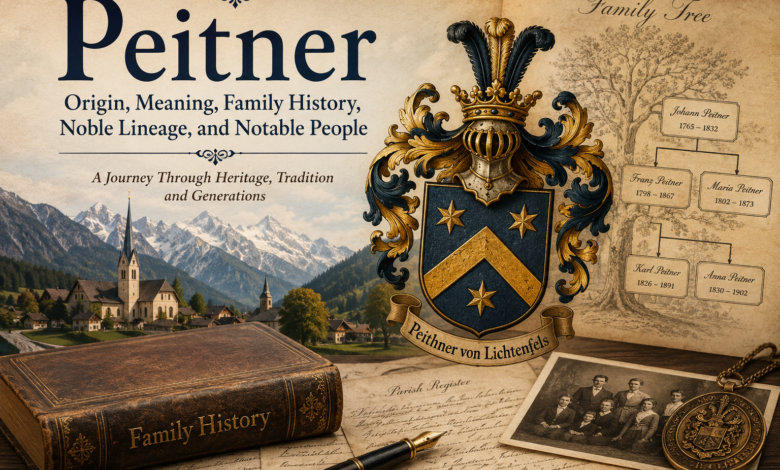
The Peitner surname carries centuries of history, reflecting a rich cultural heritage rooted in the Alpine regions of Central Europe. Although it is relatively uncommon today, the name has attracted interest from genealogists, historians, and families researching their ancestry. With connections to Bavaria, Austria, and Jewish Ashkenazic communities, Peitner represents more than just a family name—it tells a story of geography, tradition, migration, and historical legacy.
Historical records show that the surname has appeared in several forms, including Peintner and Peithner, with each spelling preserving the same historical roots. Some branches of the family achieved noble status and were granted coats of arms, while others continued as respected citizens, craftsmen, scholars, and professionals throughout Central Europe.
This guide explores the origin, meaning, history, genealogy, and notable individuals associated with the Peitner surname.
What Does Peitner Mean?
The surname Peitner is generally recognized as a topographic surname.
Topographic surnames were commonly assigned during the Middle Ages to describe where a person lived. In the case of Peitner, the name is believed to refer to someone who lived near:
- A mountain spur
- A hillside
- A rocky slope
- Elevated terrain in Alpine regions
Because many medieval communities identified people by nearby geographical landmarks, surnames such as Peitner became permanent family names that were passed down through generations.
German and Jewish Origins of the Peitner Surname
The Peitner surname has both German and Ashkenazi Jewish associations.
Its strongest historical roots are found in:
- Bavaria (Germany)
- Tyrol
- Austria
- South Tyrol
- Pustertal Valley
Families carrying this surname often lived in mountainous communities where agriculture, forestry, trade, and craftsmanship formed the backbone of daily life.
Among Ashkenazi Jewish families, surnames based on geographical features became increasingly common during the eighteenth and nineteenth centuries as governments required permanent hereditary surnames.
As a result, the Peitner surname appears in both Christian and Jewish genealogical records.
Historical Development of the Peitner Family
Historical evidence connects the surname to an old Alpine family whose history extends back several centuries.
One of the best-known historical branches is the Peintner family, documented from 1609 in the Pustertal Valley.
Over time, the surname appeared in several spellings:
- Peitner
- Peintner
- Peithner
Variations in spelling were common because local officials, church clerks, and regional dialects often influenced how names were recorded.
Despite these spelling differences, many historians recognize these forms as belonging to the same historical family tradition.
Noble Lineage and Coat of Arms
One of the most fascinating aspects of the Peitner surname is its connection to a historic coat-of-arms-bearing family.
Certain branches eventually became associated with the noble line known as Peithner von Lichtenfels, a respected family recognized within the Austrian Empire.
The granting of a coat of arms typically indicated:
- Social distinction
- Military or civil service
- Loyalty to regional rulers
- Family prestige
It is important to understand that not every person with the surname Peitner automatically belongs to the noble family. Noble titles generally applied only to specific documented family branches.
Genealogical research is required before claiming direct descent from any noble lineage.
Life in the Alpine Regions
Understanding the history of the Peitner surname also means understanding the environment in which the earliest families lived.
The Alpine regions of Bavaria and Austria were characterized by:
- Rugged mountain landscapes
- Farming communities
- Forest industries
- Trade routes through mountain passes
- Strong village traditions
Families often relied on livestock farming, woodworking, and local commerce. Community life revolved around churches, seasonal festivals, and close family relationships.
These mountain communities helped preserve family identities for generations.
Genealogy and Family History Research
Many people researching the Peitner surname begin by examining historical records from Germany and Austria.
Useful genealogy sources include:
- Parish baptism records
- Marriage registers
- Death certificates
- Census records
- Immigration documents
- Military service records
- Civil registration archives
Since spelling variations are common, researchers should also search for:
- Peintner
- Peithner
- Peitner
Checking multiple spellings often reveals additional family connections that might otherwise be overlooked.
Migration of the Peitner Family
Like many European families, individuals bearing the Peitner surname eventually migrated to other countries.
Migration occurred for several reasons:
- Economic opportunity
- Political changes
- Religious freedom
- Industrialization
- Family reunification
Today, descendants can be found in:
- Germany
- Austria
- Italy (especially South Tyrol)
- United States
- Canada
- Australia
- Other parts of Europe
Although relatively uncommon, the surname continues to be passed down through new generations.
Famous People with the Peitner Name
Several individuals have brought recognition to the surname through achievements in art, architecture, and community service.
Max Peintner
Max Peintner, born in 1937, is an Austrian architect and artist widely known for thought-provoking drawings examining the relationship between technology, consumer culture, and the natural environment.
His satirical illustrations gained international recognition and have appeared in prestigious exhibitions, including Documenta 6 and the Venice Biennale.
His work remains influential for its imaginative critique of modern society.
Tim Peitner
Tim Peitner has earned recognition as a respected youth sports coach and community volunteer.
His dedication to coaching basketball and flag football has positively influenced countless young athletes.
His commitment to volunteer service demonstrates how the Peitner name continues to be associated with leadership, mentorship, and community involvement.
Peitner, Peintner, and Peithner: What’s the Difference?
Researchers often encounter three similar spellings:
- Peitner
- Peintner
- Peithner
These differences developed over centuries because spelling standards were not always consistent.
Regional dialects, handwritten church records, and administrative practices frequently produced alternate spellings.
In many cases, these names share the same historical origins, though individual family branches may have developed separately over time.
Is Every Peitner Related?
Not necessarily.
Although many families with the surname share common geographic origins, not every modern Peitner family descends from the same direct ancestor.
Several unrelated families could independently receive similar topographic surnames based on where they lived.
Professional genealogical research and historical documentation are necessary to establish direct family relationships.
Why Family History Matters
Researching a surname like Peitner offers more than curiosity.
It helps people:
- Understand their ancestry
- Preserve family traditions
- Connect with relatives
- Learn about migration patterns
- Appreciate historical heritage
- Pass family stories to future generations
Genealogy has become increasingly popular thanks to digitized archives and historical databases that make centuries-old records easier to access.
The Legacy of the Peitner Name
The Peitner surname represents resilience, heritage, and continuity.
From mountain communities in Bavaria and Austria to families living across the world today, the name reflects centuries of adaptation while maintaining a connection to its Alpine origins.
Whether linked to noble families, artistic achievement, community leadership, or ordinary hardworking ancestors, the surname continues to carry historical significance.
For descendants researching their roots, the story of Peitner serves as a reminder that every family name preserves a unique chapter of history waiting to be discovered.
Conclusion
The Peitner surname has deep roots in the German-speaking Alpine world, where geography, community, and history shaped its identity. Originating as a topographic name associated with mountain slopes and ridges, it later appeared in several historical forms, including Peintner and Peithner. Some family branches achieved noble recognition, while others contributed to society through architecture, art, public service, and community leadership.
Today, the surname remains an important subject for genealogists and family historians seeking to understand European ancestry. Whether you carry the name yourself or are simply exploring surname history, Peitner represents a fascinating example of how family names preserve centuries of cultural and historical heritage.
Frequently Asked Questions (FAQs)
What does the surname Peitner mean?
Peitner is a topographic surname that traditionally referred to someone who lived near a mountain spur, hillside, or slope in the Alpine regions.
Where does the Peitner surname originate?
The surname has origins in Bavaria, Austria, Tyrol, and surrounding Alpine areas. It also appears in Ashkenazi Jewish family histories.
Is Peitner a noble family name?
Some historical branches, particularly the Peintner and Peithner families, were associated with noble lineages and coats of arms. However, not every person with the surname belongs to those branches.
Are Peitner and Peintner the same surname?
They are considered historical spelling variants that often share the same geographical and linguistic roots.
Who are some well-known people with the surname?
Notable individuals include Austrian architect and artist Max Peintner and youth sports coach Tim Peitner, both recognized for contributions in their respective fields.