Tech Giants Envision a Future Beyond Smartphones: The Next Era of Digital Innovation
How AI, Smart Glasses, and Wearable Technology Are Shaping the Future of Digital Interaction

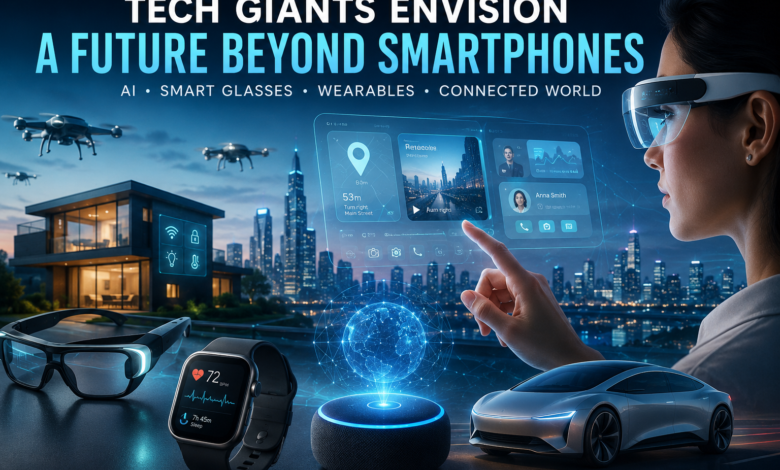
Tech Giants Envision a Future Beyond Smartphones
Introduction
For more than a decade, smartphones have remained at the center of modern digital life. People use them to communicate, work, shop, entertain themselves, navigate cities, and manage daily activities. Their influence has transformed industries and reshaped consumer behavior across the globe. However, technology leaders are now looking beyond traditional smartphones and investing heavily in new innovations that could redefine how people interact with the digital world.
The concept of a future beyond smartphones may sound surprising, considering how deeply these devices are integrated into everyday life. Yet many of the world’s leading technology companies believe the next major technological shift is already underway. Advances in artificial intelligence, augmented reality, wearable devices, and ambient computing are creating opportunities for entirely new forms of digital interaction.
As innovation accelerates, consumers may soon experience technology that feels more natural, seamless, and integrated into their environments than ever before.
Why Smartphones May No Longer Dominate Technology
Smartphones have achieved remarkable success, but they are also approaching a level of maturity where revolutionary improvements become increasingly difficult. Modern devices already offer powerful processors, high-quality cameras, large displays, and extensive app ecosystems.
Technology companies are therefore searching for the next platform capable of delivering transformative experiences. Rather than relying on a single handheld device, future technologies may distribute computing capabilities across multiple connected products. This shift could allow users to access information and services without constantly looking at a screen.
The goal is not necessarily to eliminate smartphones immediately but to reduce dependence on them by introducing smarter and more intuitive alternatives.
The Rise of Artificial Intelligence-Powered Devices
Artificial intelligence is expected to play a central role in the post-smartphone era. AI systems are becoming more capable of understanding language, recognizing patterns, and providing personalized assistance in real time.
Future devices may function as intelligent companions that anticipate user needs and perform tasks automatically. Instead of manually opening applications and navigating menus, users could simply speak naturally or rely on contextual assistance generated by AI.
Imagine scheduling appointments, ordering products, managing travel plans, or receiving health recommendations through conversational interactions. Such capabilities could significantly reduce the need for traditional app-based experiences.
As AI continues to evolve, technology companies are investing in hardware specifically designed to support advanced machine learning and intelligent automation.
Smart Glasses and Augmented Reality Experiences
One of the most discussed alternatives to smartphones is smart glasses powered by augmented reality. These devices have the potential to display digital information directly within a user’s field of vision.
Rather than checking a phone screen for directions, messages, or notifications, users could see relevant information seamlessly integrated into their surroundings. Navigation prompts, translation tools, productivity features, and entertainment experiences could appear naturally while people move through the world.
Augmented reality technology is also gaining attention in education, healthcare, engineering, retail, and remote collaboration. Professionals may be able to access instructions, visual data, and expert guidance without interrupting their workflows.
Although technical challenges remain, ongoing investments suggest that smart glasses could become a major computing platform in the future.
Wearable Technology Becoming More Advanced
Wearable devices have already become popular through fitness trackers and smartwatches. However, future wearables are expected to offer capabilities far beyond simple health monitoring.
Next-generation wearable technology may continuously analyze biometric information, track wellness indicators, and provide proactive insights that help users make informed decisions about their health and lifestyle.
Some innovators are exploring devices that can monitor stress levels, sleep quality, physical activity, and environmental conditions. These advancements could support preventive healthcare and improve overall well-being.
As sensors become smaller and more efficient, wearable technology may gradually assume many functions currently performed by smartphones.
Voice Interfaces and Ambient Computing
The future of computing may involve less screen interaction and more natural communication methods. Voice interfaces are becoming increasingly sophisticated, allowing users to complete tasks through conversation rather than touch-based controls.
Ambient computing represents a broader vision where technology blends into everyday environments. Devices, sensors, and AI systems work together behind the scenes to provide assistance when needed.
In such an environment, users may not need to think about which device they are using. Technology becomes an invisible layer that responds intelligently to context, location, and personal preferences.
This approach aims to make digital experiences more convenient while reducing friction in everyday interactions.
The Evolution of Smart Homes and Connected Ecosystems
Connected ecosystems are another important component of the future beyond smartphones. Smart homes already include intelligent lighting systems, security devices, entertainment platforms, and voice-controlled assistants.
As interoperability improves, these technologies may operate together more effectively. Consumers could manage multiple aspects of their lives through interconnected systems that communicate seamlessly.
For example, a smart home could adjust lighting, temperature, music, and security settings automatically based on individual routines. AI-powered ecosystems may also provide energy-saving recommendations and improve household efficiency.
The integration of connected devices creates a foundation for more personalized and responsive digital experiences.
Challenges Facing the Post-Smartphone Era
Despite significant progress, several challenges must be addressed before new technologies can replace smartphones on a large scale.
Privacy remains a major concern. Devices that continuously collect data must implement strong security measures to protect user information. Consumers will also expect transparency regarding how their data is stored and utilized.
Battery life, affordability, hardware limitations, and user adoption present additional obstacles. New technologies must offer meaningful advantages while remaining accessible to a broad audience.
Furthermore, developers, businesses, and consumers need time to adapt to emerging platforms and establish new usage habits.
What Consumers Can Expect in the Coming Years
The move toward technologies that extend beyond smartphones is expected to happen over time, allowing users and industries to adapt gradually to new digital experiences. Smartphones will continue serving important functions for many years while newer technologies gain popularity.
Consumers can expect increased integration of artificial intelligence, more sophisticated wearable devices, enhanced augmented reality experiences, and smarter digital ecosystems. These innovations will likely complement smartphones before eventually reducing dependence on them.
Technology companies are focusing on creating experiences that feel more intuitive, personalized, and efficient. The ultimate objective is to make digital interaction less intrusive and more naturally integrated into daily life.
As research and development continue, entirely new categories of devices may emerge that reshape how people communicate, work, learn, and engage with technology.
Conclusion
The future beyond smartphones is becoming one of the most exciting discussions in the technology industry. Leading innovators are exploring artificial intelligence, smart glasses, wearable technology, ambient computing, and connected ecosystems as potential foundations for the next generation of digital experiences.
While smartphones are unlikely to disappear overnight, the technology landscape is clearly evolving. Future devices will aim to provide greater convenience, deeper personalization, and more seamless interactions with the digital world.
As these innovations mature, consumers may witness a transformation comparable to the smartphone revolution itself. The coming years could mark the beginning of a new era where technology becomes increasingly intelligent, connected, and integrated into everyday life.